
Some of Garry Winogrand’s photographs look as though the people in them are trying to pull the frame apart. Bodies turn in different directions. Faces register separate conversations. Something happens near the edge while you’re still trying to understand the people in front. He could hold all of that inside one photograph without making everyone look as though they’d rehearsed their part.
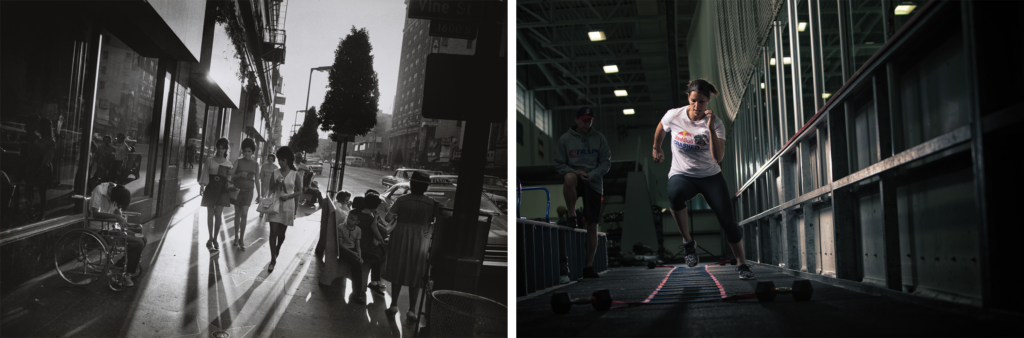
Left: Garry Winogrand, Los Angeles, California, 1969. © The Estate of Garry Winogrand. Right: Aaron Belford, Myriam during Crashed Ice ladder drills. Steps, arm positions and the space between the feet let you follow movement across the body.
Winogrand could catch a gesture across an entire body. Follow the face down through the shoulders, the hands, the angle of the hips and the placement of the feet. You begin to see how a person occupies the world. Someone leans into a conversation. Another person has already turned toward somewhere else. A foot extends into an opening that will be gone with the next step.
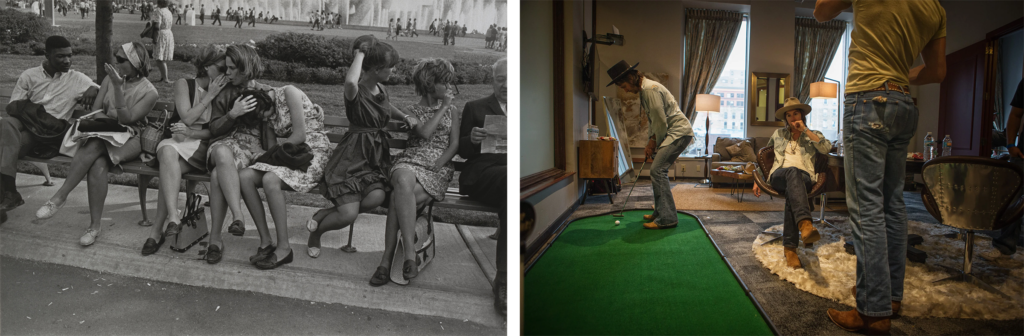
Left: Garry Winogrand, New York World’s Fair, 1964. © The Estate of Garry Winogrand, courtesy Fraenkel Gallery. Right: Aaron Belford, Midland in the green room. One member putts at the far left while the others occupy the room differently. Follow the separate gestures across each frame.
People described his photographs as choreography. That’s a useful description because it sends you back into the picture with something specific to look for. Separate people briefly become an arrangement. They might have no relationship outside the photograph, but inside it, their movements answer one another.
The camera stops them long enough for us to notice.
Calling that a lucky shot is a convenient way to avoid discussing the work. Winogrand had to recognize the possibility, get himself into position and release the shutter while the relationships still existed. The people supplied the movement. He made the photograph.
He could also miss. Often. His willingness to attempt pictures that might collapse is part of what made his photographs so great. He kept testing how much a photograph could contain. A safe arrangement would have been easier to repeat, but repetition would have answered very little of what interested him.
That’s a more demanding ambition than developing a recognizable look and spending the rest of your career defending it.
His photographs could be funny, affectionate, uncomfortable and difficult to explain. Sometimes the humor came from a gesture. Sometimes it came from two things sharing a frame that had no business looking so appropriate together. He could find an entire human predicament in people waiting, walking or watching something beyond the edge.
He also understood how little the photograph could explain. We can examine someone’s expression without knowing what caused it. We can invent a relationship between strangers because he caught them standing together. His pictures give us plenty to interpret, along with good reasons to question our interpretation.
That’s more interesting than a photograph that arrives with its meaning already underlined.
Left: Garry Winogrand, Cowboy, Hat on Edge of Frame, Rodeo, 1974. © The Estate of Garry Winogrand. Right: reserved for Aaron Belford’s photograph of a rider being thrown, with a boot hanging in midair.
There was physical intelligence in how he worked. People compared him to a basketball player. Ready to move, change direction and respond. The description fits the photographs because his position determined which bodies overlapped, which gestures remained visible and how the surrounding activity entered the frame.
People have described me as a boxer when I shoot. I move in and out, get low, come up and work around the subject. I recognize that physical search in Winogrand. I’m trying to find the position where the body, the expression and the environment become readable together.
A few inches can change the picture. A hand separates from a torso. A face clears a background object. Moving back reveals somebody reacting to the action. Getting closer gives an expression enough space to become the reason for the photograph.
You can’t solve all of that by standing somewhere comfortable and buying a better lens.
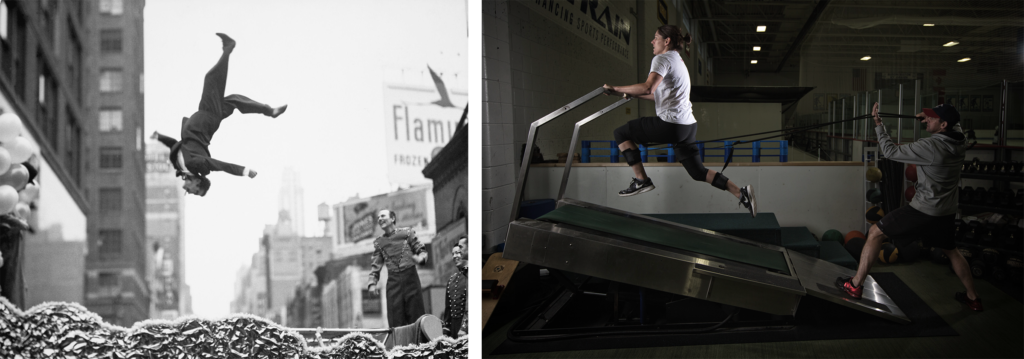
Left: Garry Winogrand, New York, 1950s. © The Estate of Garry Winogrand, courtesy Fraenkel Gallery. Right: Aaron Belford, Crashed Ice off-season training. Limbs separate against the surroundings and make the movement readable.
That’s where I feel a connection between his approach and the work I want to make. In fitness photography, I’m interested in how effort travels through the body. The grip, the shoulders, the expression, the stance. I want enough of the person visible that you can understand what they’re doing and feel something of the effort.
With some of my subjects, that interest extends through training, practice and competition preparation. There’s a finished presentation, but there’s also the work required to produce it. Photographing that gives me more to explore than asking them to repeat a pose until I’ve collected enough versions.
Too much direction can replace a person’s own gestures with the photographer’s favorite instructions. I want to recognize when something better is already happening.
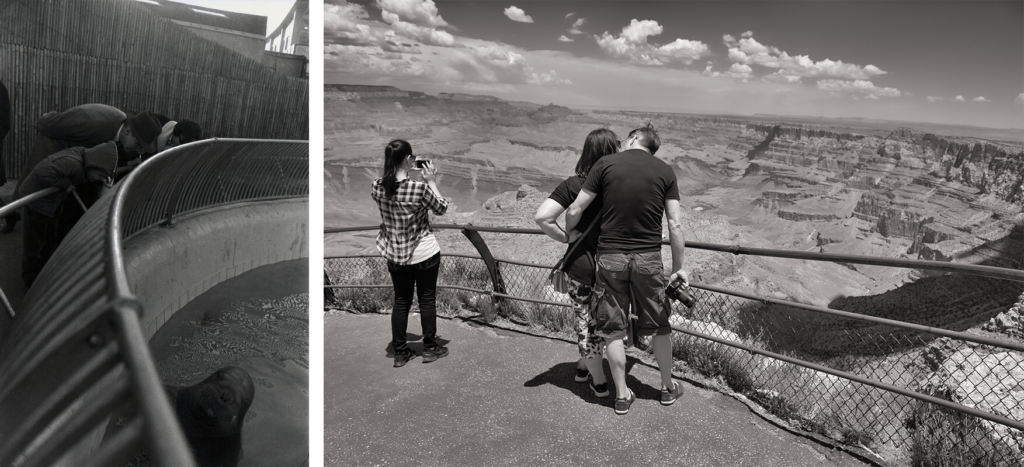
Left: Garry Winogrand, New York City, 1964. © The Estate of Garry Winogrand. Right: reserved for Aaron Belford’s Grand Canyon tourist photograph.
Winogrand found material in the life he was actually living. The zoo photographs are a particularly affectionate example. He took his children to the zoo, and he photographed there. A father spending time with his kids was also a photographer watching the peculiar exchanges between people and animals.
What a generous subject. People arrive to look at animals, and the people become equally worth looking at. Attention goes in several directions. Something appears, somebody misses it, another person reacts. The outing supplies situations too strange and specific to improve by arranging them.
Those photographs now hold pieces of America’s past. So do the streets, airports and public gatherings he photographed in New York and during his travels. The clothes and surroundings locate the pictures in time. The gestures let us recognize the people across the years.
My own photographs have accompanied military service, documentary work, and travels where I went looking without knowing what I would find. Later came stock photography and commercial assignments. Through those changes, I kept wanting pictures of what it felt like to encounter a person or a place.
Winogrand gives me a way to examine that desire more closely. What did I actually see? How much of it survived inside the frame? Did I leave room for the gesture, the surroundings and the person I almost overlooked?
His work makes me suspicious of my first satisfactory picture. There may be another relationship forming while I’m congratulating myself. Another expression. Somebody entering at the edge.
I want to stay available for that. I’ve directed plenty of photographs. I still want to be surprised by someone who has no idea what picture I had in mind.