
Friday, October 23, at one in the afternoon, I drew my square and started looking around Minneapolis. Then family trouble started. I had to step away from the event to deal with it. By the time I came back, I couldn’t pick up the camera.
It was raining. The sky was gray. Those things didn’t help, but they weren’t the reason I stopped shooting. I was depressed, distracted and stuck with problems I couldn’t fix by walking around with a camera.
Saturday morning, I got up around four. We started shooting around six. The sun was out, and for a while I thought maybe the day would open up. I was in my assigned square. I saw the buildings, the lake, the people. But I wasn’t creatively present. Nothing caught hold. I could make photographs. I couldn’t make ideas come together.
I kept shooting until about one, then left to work through the files. I didn’t feel confident about what I had. I felt like the family trouble had taken a piece of the twenty-four hours I’d paid for and couldn’t get back.
Then I started editing. The pictures began to show me what I hadn’t been able to name while I was making them. The turmoil was in there. I had photographed the world around me, but I had also put myself into it.
That became the real assignment.
Seventy photographers took part in MSP Squared, the ASMP event built around assigned squares in Minneapolis and a twenty-four-hour challenge. I was ready for a long day of photography. I wasn’t ready for my own emotional state to decide how much of that day I could use.
The Five I Submitted
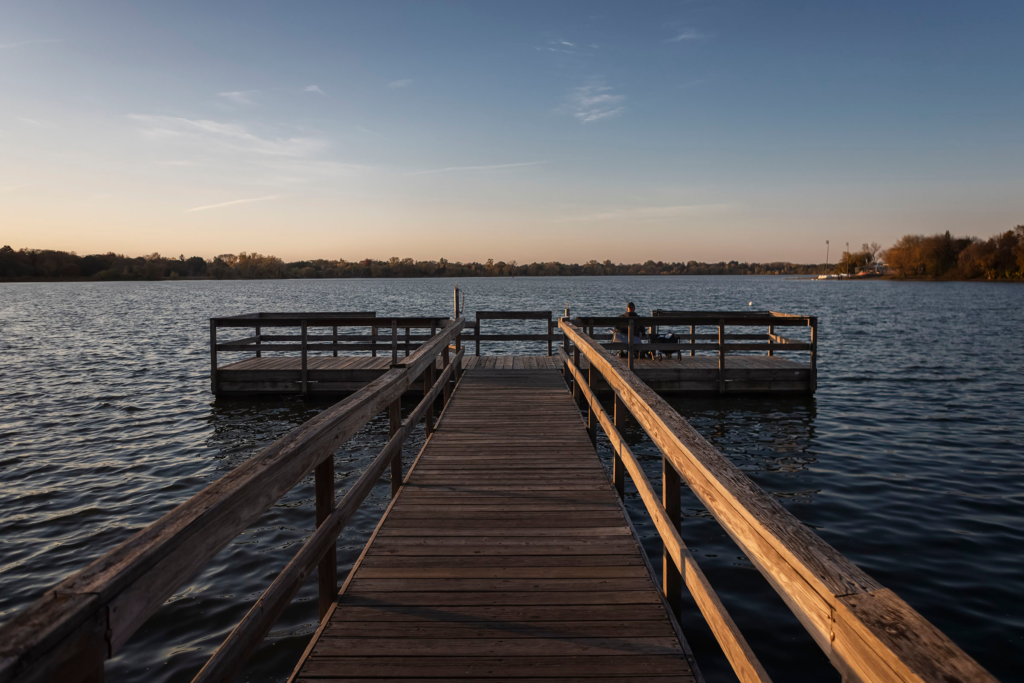
Old Man on the Dock
This was the first picture I settled on. It’s a standard T-shaped dock at Lake Nokomis, with a man sitting near the right side, fishing alone. The lake is beginning to ripple in the wind. The scene looks calm. The man looks alone.
I was trying to make something that looked normal. Familiar. Minnesota. A picture that could sit neatly inside the version of the morning people expected to see.
The dock forms a big orange T against the blue water. The warm wood and sunrise light pull one way. The cool blues pull the other. I meant to use that tension. Orange held heat and creativity for me. Blue held the sadness I was carrying. I wanted the photograph to look settled. It wasn’t.
At first, I told myself the dock was ordinary, the man barely visible, the sky empty. Some of that criticism holds. But I was also trying to make an image that looked normal while I felt anything but. The photograph gave me away.
You can find the fishing rod and the wagon if you look. You can see the man sitting there with the lake. I wasn’t trying to show his face. The distance was part of the picture. I just didn’t understand how much of my own distance I had put into it.
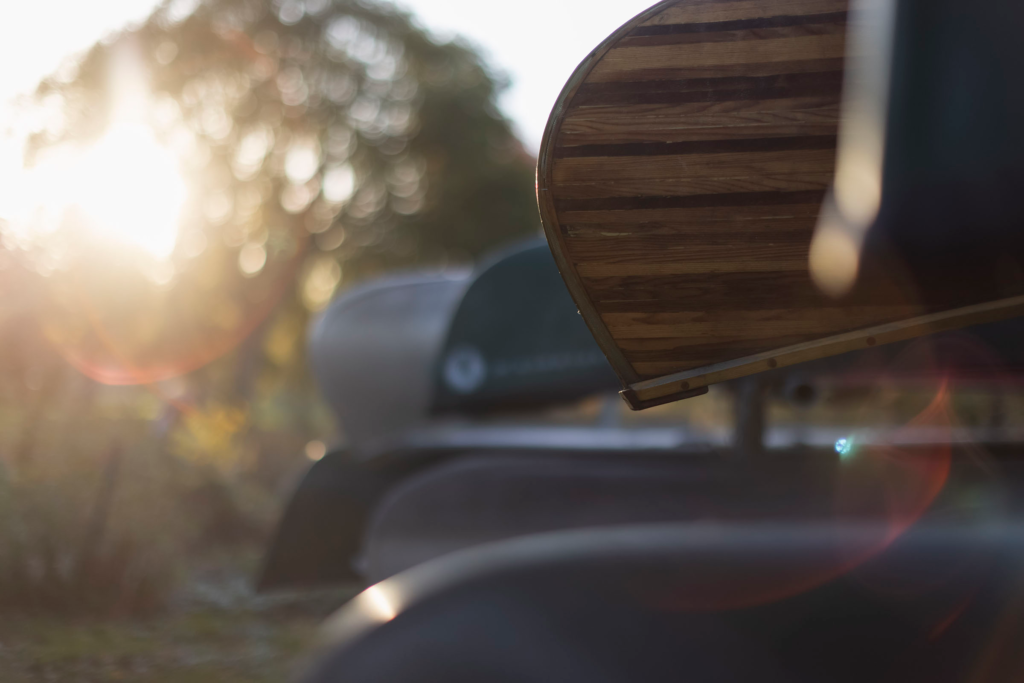
Morning Wood
The wooden canoe sits sharp in the upper right. Aluminum and fiberglass canoes blur around it. The sun flares across the frame.
I saw a split between the manufactured boats and the wood canoe. The others felt artificial to me. The wood held warmth. It felt honest, clear and close to nature. It was the part of the picture I wanted to bring forward.
Then there’s that flare. I was pushing brightness into the image, trying to force a little light into a weekend that felt dark. The flare looks forced because it was forced. I wanted something positive to break through. It didn’t make the rest of the picture disappear.
The wooden canoe is trying to stay in focus while everything around it competes for attention. That felt familiar. I was trying to hold on to the part of myself that was still clear while the rest of the world crowded in.
I called it “Morning Wood.” The title is a joke. The photograph isn’t. I like the reduced colors, the wood grain and the cold aluminum against the warmer canoe. I also see how hard I was trying to make the image say something bright.
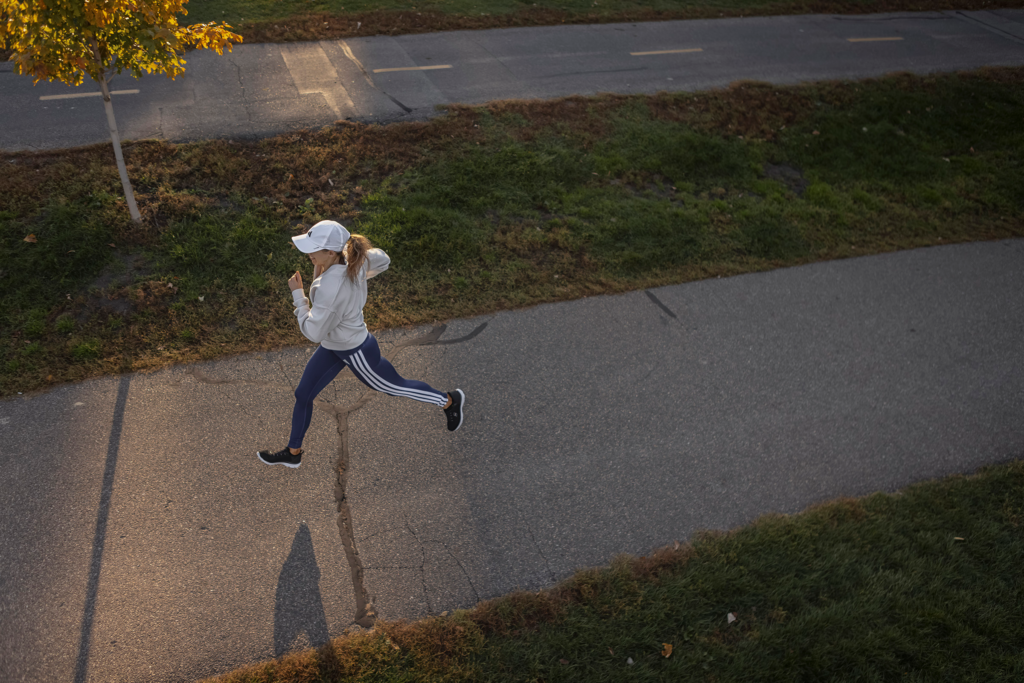
Floater
Sandy came with me to try to lift my spirits. I photographed her running down the path, both feet off the ground, moving out of the frame. Her face is hidden by her hat.
I wanted the runner to stay indistinct. I wasn’t trying to turn her into a fitness advertisement or make the photograph about her body. I wanted the movement, the cold light, the path and the space around her.
The direction bothers me. She’s running left, out of the frame. We read a picture from the upper left toward the lower right. If I had reversed the frame, the movement might have felt more resolved. I didn’t. She’s running away from the empty, cold space behind her, toward something we can’t see.
That’s what I see now. I was trying to run from the problem. I wanted distance from the dark mood, from the cold morning, from the feeling that I couldn’t make the day go the way I wanted.
Sandy was trying to help me. I wasn’t ready to be helped. The photograph doesn’t explain that, and it shouldn’t have to. But knowing it changes what I see when I look at her leaving the frame.
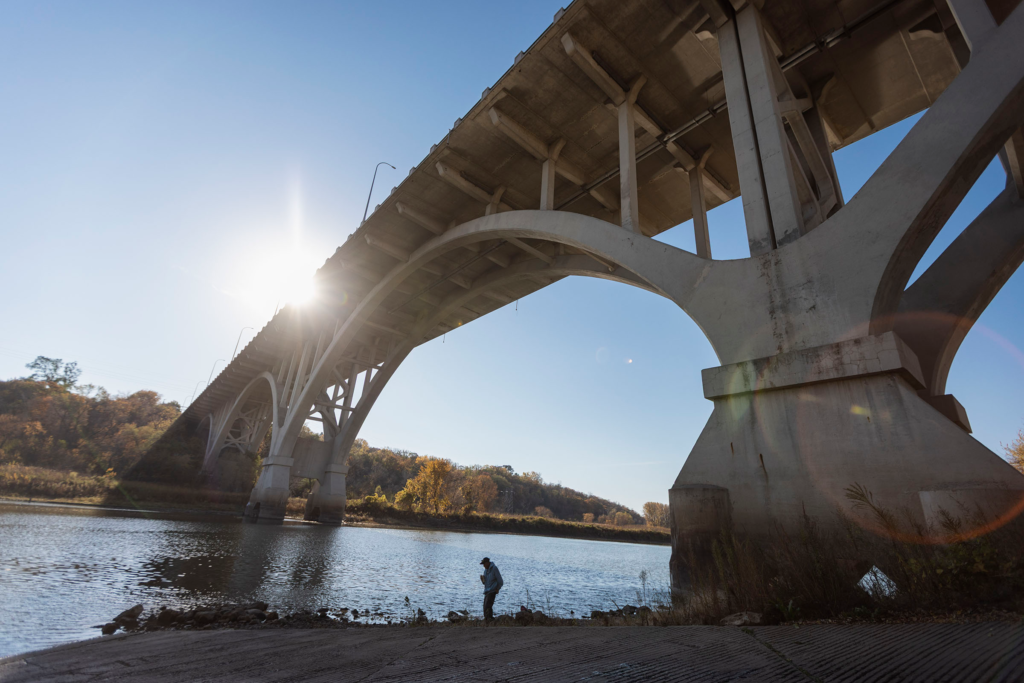
Under the Bridge and Dreaming
I left Lake Nokomis and went to the wild-card area beneath the Mendota Bridge. The scale hit me first. A huge concrete structure over the river, traffic carrying people and commerce into the city, and one man fishing beneath it.
You can’t see his rod. You see him in silhouette, turned toward the water. He’s small under the bridge. His shoulders look slumped. I read him as defeated, looking for a little peace below all that movement. I don’t know his life. That was my reading of the figure, and it came from the state I was in.
There was noise above him. Traffic, the bridge, the city moving. Underneath, the frame felt quiet. Melancholy, too.
The concrete is yellow, almost aggravating in the light. The flare travels from the upper left toward the lower right. Small circles of lens reflection sit near the bridge footing. They look beautiful. They also add more visual noise to a picture that already has plenty going on.
I wanted the flare to pull your eye toward the bridge. I wanted the bridge to frame the man. I wanted the man to feel small beneath something impersonal and enormous. I got those things, but I also made a busy picture. The color version felt like the whole weekend: a lot happening, no clear point of attention.
At the judging, someone said, “Oh, look, it’s a wide-angle lens.” It is. The lens helped me show the scale. But the photograph is about more than the lens. I was disappointed they didn’t see more in it. I also had to consider that I made the picture for myself. I knew all the thoughts I had put into it. The people in the room got the frame.
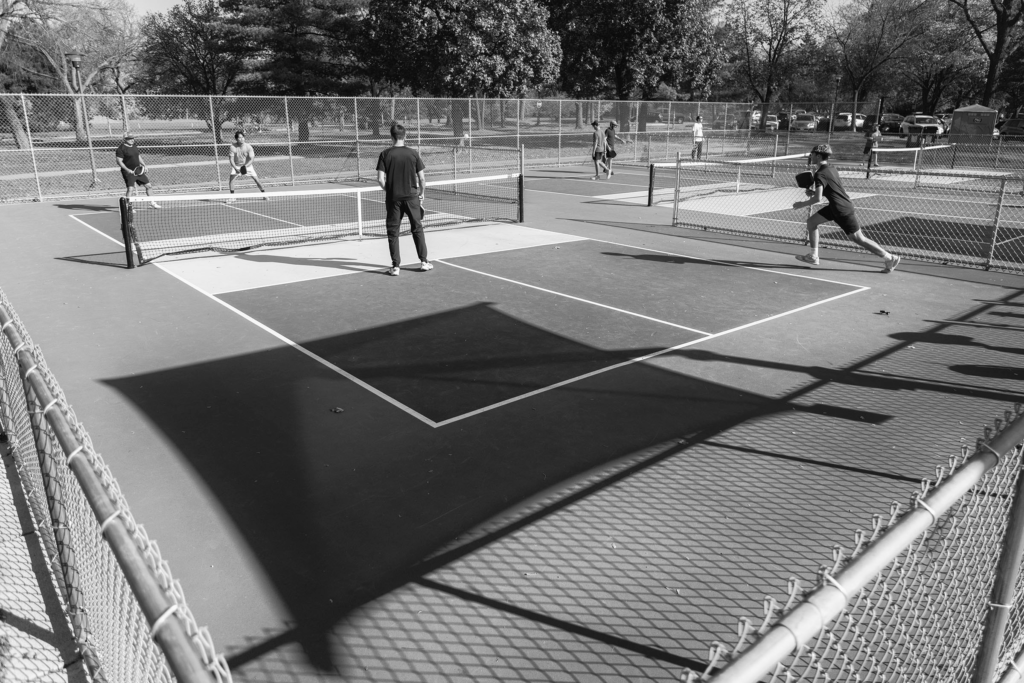
Lazy Tennis
I was trying to photograph people. I wasn’t feeling people. I wanted to be alone, away from the noise in my own head. So I walked around the pickleball court and made myself look.
One player lunges forward. The others stand in different states of stillness. The court lines and the chain-link fence build a web of squares and diamonds. A large square shadow cuts across the court. I saw the people moving around inside it, and the dark shape started to feel like a hole pulling them in.
I called the picture “Lazy Tennis.” That title came from my irritation. One person was moving. Everyone else seemed to be waiting. I saw myself in the player lunging toward the action, trying to push toward something fun while the world around me stayed still.
The color was too chaotic for what I wanted. I went to black and white and tried to pull detail out of the dark square. It still didn’t feel fully resolved.
This is the picture where I can see myself trying to engage and not quite getting there. The shapes are deliberate. The feeling is not. I was looking for a way into the scene while part of me wanted to disappear from it.
The Three I Didn’t Submit
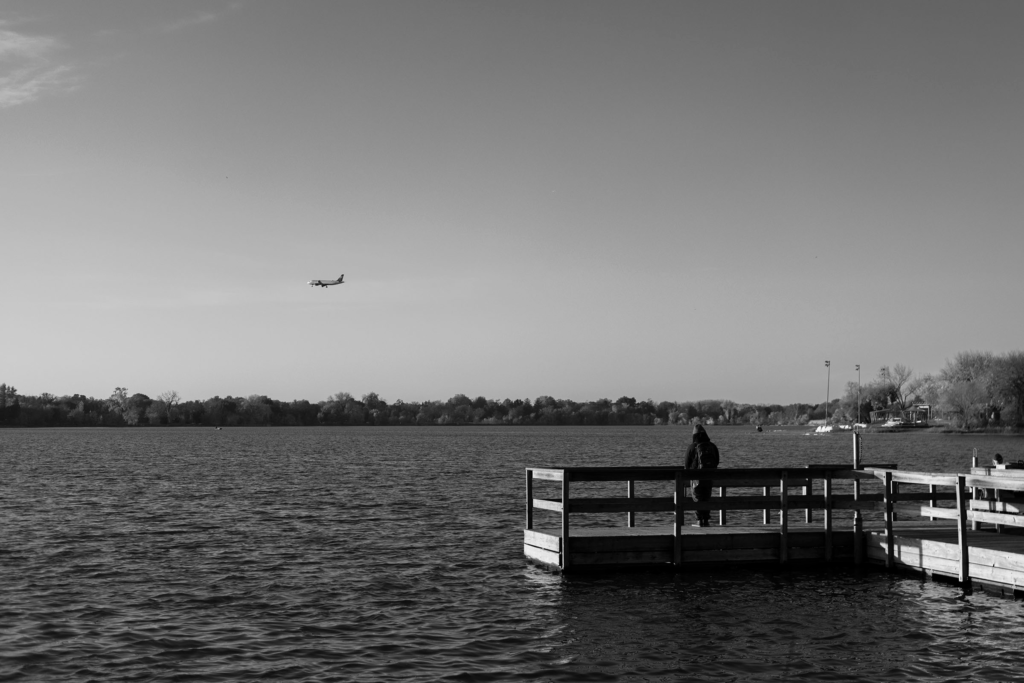
The Dock and the Airplane
This is the black-and-white dock picture. The man is weighted down in the lower-right corner. A small airplane comes in over the lake toward Minneapolis–Saint Paul International Airport.
The airplane catches your eye first. Then the dock pulls it down to the fisherman. If you run around the lakes north of the airport, you know that morning: the path, the lake, the plane coming in low. The black and white gives the scene a quieter, more timeless feel.
I knew it was different from the color dock picture. I knew it had a Minnesota-specific feeling. But it didn’t hit me when I was choosing. I left it out. Sometimes an image can have good parts and still fail to reach you. That’s what happened here.
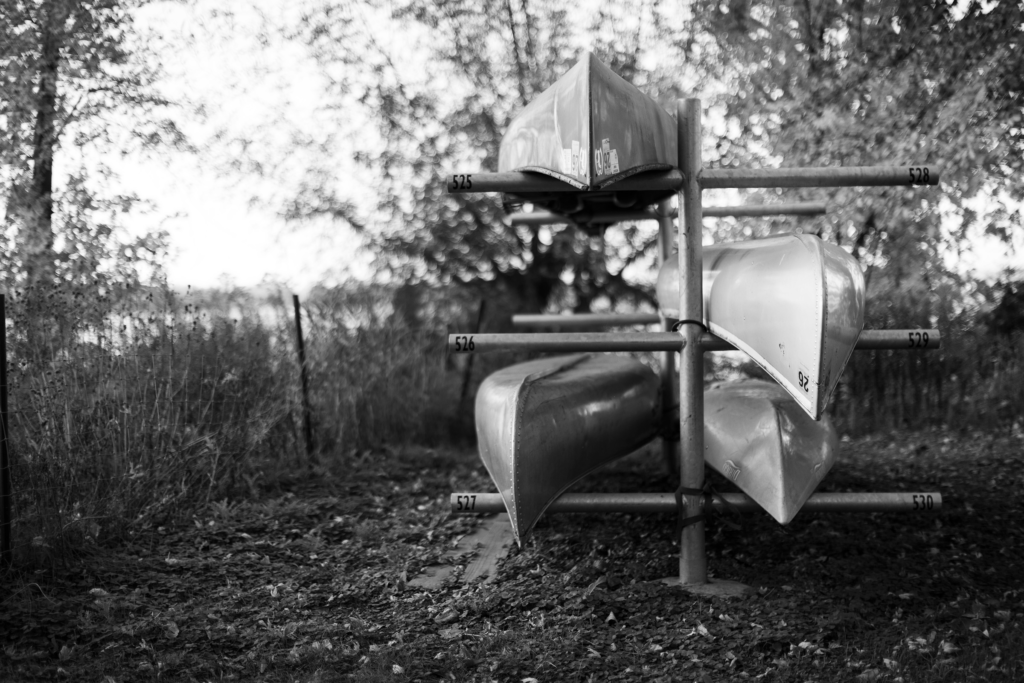
The Canoe Tree Rack
The canoes hang from a rack like branches on a tree. The boats are weighted to the right, leaving open space on the left. Numbers run down the rack. The black-and-white treatment makes the shapes stand out.
I liked the space on the left. It’s the kind of room a designer could use for a title or copy. That’s a commercial instinct I use often. The frame also carried a familiar Minnesota feeling for me.
But it didn’t speak to me. I could explain the layout. I could explain the numbers and the canoe-tree shape. I couldn’t find the reason I wanted to keep looking at it. So I didn’t submit it.
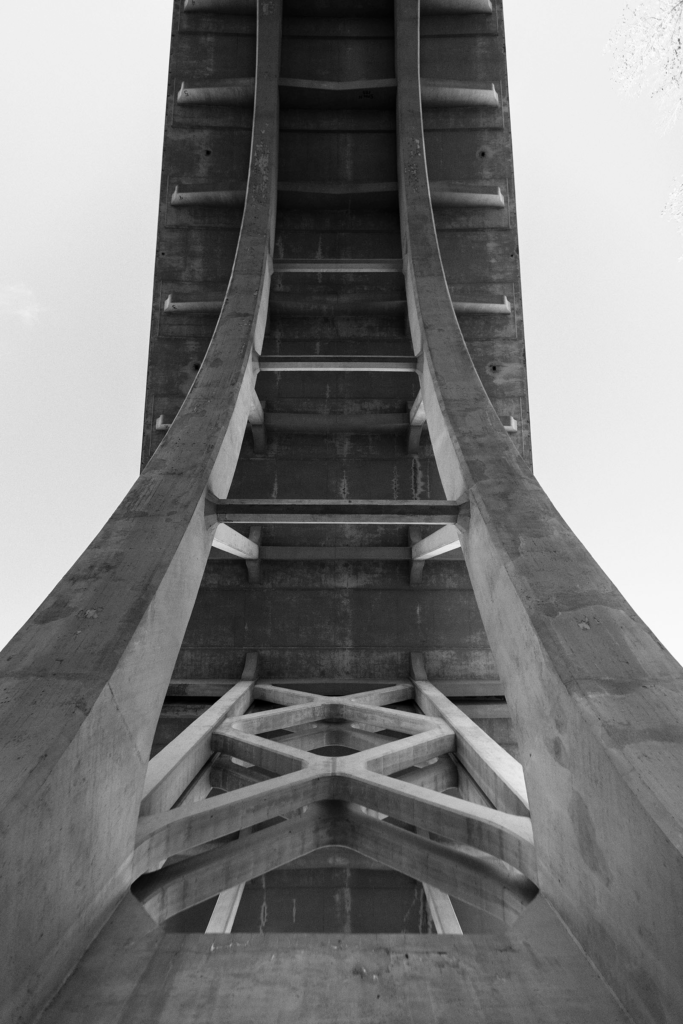
The Bridge, Looking Up
This vertical black-and-white frame looks up through the Mendota Bridge. The structure rises like a spire, almost an Eiffel Tower made of concrete. The contrast brings out the shapes and details.
It’s a strong composition. I left it out because it felt mostly compositional. The photograph of the man beneath the bridge had more of the sadness and isolation I was trying to understand. It felt closer to what I was carrying.
That may not make it the better photograph for everyone else. It made it the one I chose.
The Judging and What Survives
The judging had a lot to get through. Seventy photographers took part, many submitted five images, and the largest category had 119 photographs. I appreciate the judges taking on that workload. I appreciate ASMP for putting the event together, and I’m glad my creative guild, my union, or whatever name fits, gave us a reason to make work and put it in front of one another.
The pace felt rushed at times. There was banter when I wanted more direct feedback. With that many images, a tighter pace and clearer comments would have helped. Still, I don’t want to make this a complaint about the judges. My pictures meant more to me than they meant to the room. That’s on me to reckon with.
I didn’t resent photographs that got more attention, even when they had technical problems. A photograph can be imperfect and still get under someone’s skin. Mine had composition, color, geometry and intention. They didn’t always give the audience a clear way in.
That’s the question in What Survives: what remains after the maker leaves? I had built a private emotional map into these frames. The audience didn’t have that map. They saw the images, not the family trouble, the rain, the pause, the early morning, or the effort it took to keep shooting.
This event became a kind of therapy, though I hadn’t signed up for that. I went in ready to shoot for twenty-four hours. I didn’t expect the photographs to show me how much of my own turmoil I was carrying. Friday’s rain and Saturday’s sun became part of the story in my head. The dark cloud I felt didn’t lift when the weather cleared.
I’m grateful to the other photographers who made the work and to the judges who gave their time. I wish the judges had seen more in some of my images. I also know I was making them for myself, not thinking hard enough about what a stranger would take from them.
I could keep operating the camera. That wasn’t the same as being present. The photographs show the difference.